
The Benefits of Bedtime Stories: What Science Actually Says
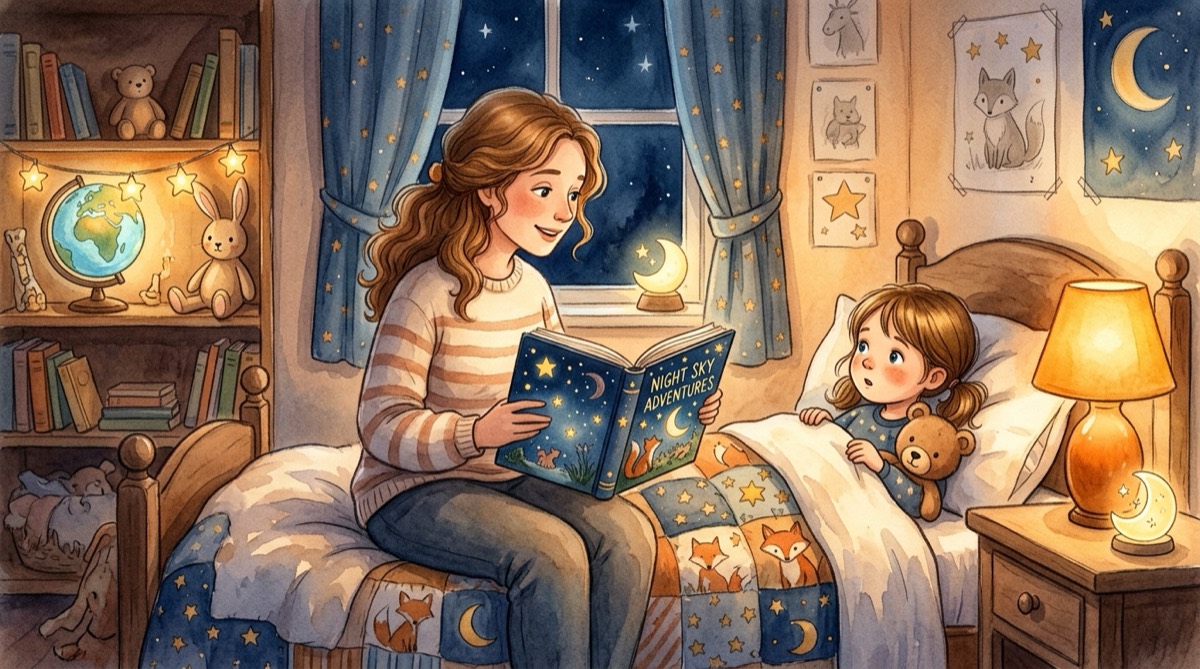
Every evening, in millions of families, the same small miracle happens: a child slips under the covers, a parent sits on the edge of the bed, and a story begins. The ritual looks simple, almost trivial. It is actually one of the most studied — and most beneficial — parenting habits research has ever documented.
Easier bedtimes, more stable nights
The largest study ever conducted on bedtime routines followed more than 10,000 children across 14 countries. Published in the journal Sleep (Mindell et al., 2015), it found a "dose-dependent" effect: the more regular the evening routine — bath, cuddle, story — the faster children fall asleep, the fewer night wakings they have, and the longer they sleep. And it works at every age from 0 to 5.
The bedtime story plays a central role: it is a calm, predictable, reassuring activity that signals to a child's brain that the day is ending. Unlike a cartoon, it involves no blue light and no fast-paced stimulation — two factors known to delay sleep onset.
A language accelerator
As early as 1995, a landmark meta-analysis (Bus, van IJzendoorn & Pellegrini) concluded that shared reading is one of the strongest predictors of later reading success. The reason is simple: books and stories contain richer vocabulary and more varied sentence structures than everyday conversation. Listening to stories means meeting words, every night, that a child would never have encountered anywhere else.
This is also why the American Academy of Pediatrics has officially recommended shared reading from birth since 2014 (High & Klass, Pediatrics): the language benefits build up long before a child can speak.
A moment that soothes — child and parent alike
A study published in Pediatrics in 2018 (Mendelsohn et al.) followed families over several years: shared reading and play significantly reduced hyperactivity and attention difficulties, with effects still measurable a year and a half after the programme ended. The researchers point to a key mechanism: these calm, one-on-one moments strengthen the parent-child relationship — what psychologists call the attachment bond.
And the benefit goes both ways: many parents describe the bedtime story as the sweetest moment of their day — the one where the phone goes down and you truly reconnect.
How to make it a habit that sticks
- Same time, same ritual: consistency matters more than duration. Ten minutes every night beats one hour on Sundays.
- Story last: right before lights out, after bath and teeth, so the story → sleep association settles in.
- Follow their passions: dragons, firefighters, unicorns… a child hooked on the topic asks for their story instead of enduring it.
- Vary the formats: a book, an invented tale, an audio story you listen to together — what matters is the shared moment and the voice telling it.
That is exactly the belief behind Plume: personalised stories, narrated in a gentle voice, so this small miracle can happen every night — even on the nights when a parent's imagination runs dry.
What if tonight's story was written for your child?
In a few minutes, Plume invents a one-of-a-kind story — their name, their passions, their day — and narrates it in a gentle voice.
Create their storyReady in under 2 minutes