
Helping Your Child Fall Asleep Faster: the Bedtime Routine That Works
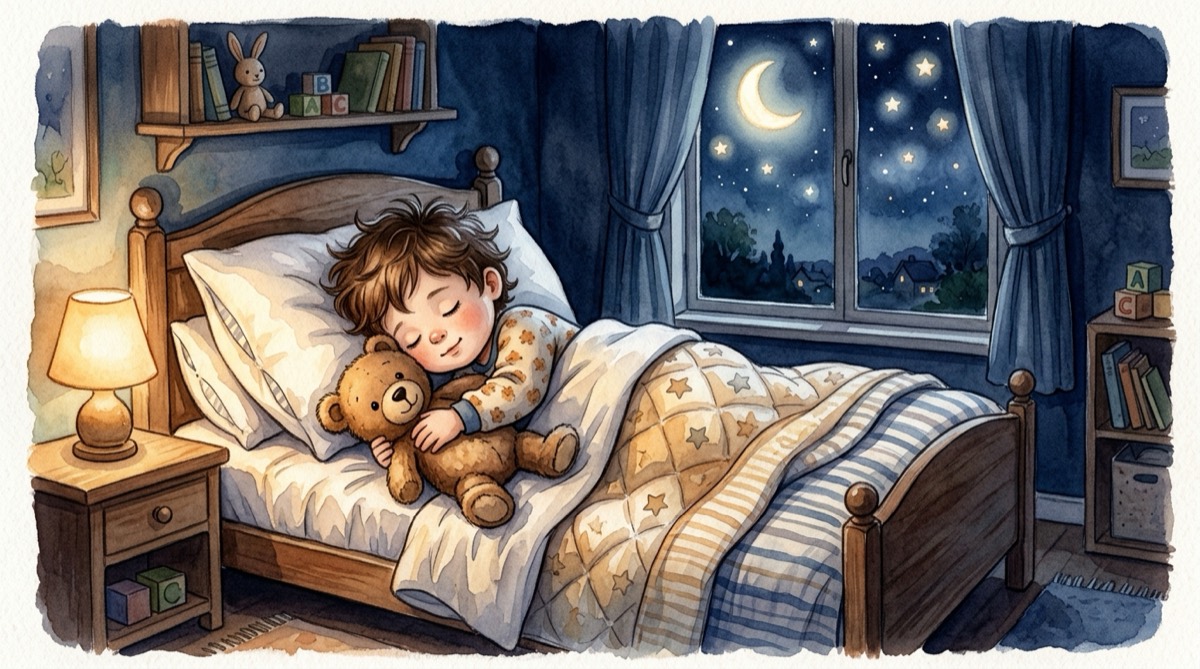
"Five more minutes", "I'm thirsty", "there's a monster under the bed"… If bedtime at your house feels like an endless negotiation, you are not alone: up to one child in four struggles to fall asleep. The good news is that sleep science has a surprisingly simple answer — one that requires no miracle method and no tears.
What the research says
In 2018, two paediatric sleep specialists reviewed all the available evidence (Mindell & Williamson, Sleep Medicine Reviews). Their conclusion: a consistent bedtime routine is associated with falling asleep faster, fewer night wakings and better overall sleep — and its benefits reach far beyond the night, with positive effects on language, emotional regulation and even the parent-child relationship.
The landmark 2015 study of more than 10,000 families across 14 countries had already shown the effect is "dose-dependent": every additional routine night per week measurably improves sleep. A routine practised every single night is associated with falling asleep almost twice as fast as no routine at all.
The study-backed bedtime routine
An effective routine lasts 20 to 40 minutes, always in the same order. For example:
- Bath time — the drop in body temperature that follows naturally promotes drowsiness;
- Pyjamas and teeth — repeated gestures that "announce" the night;
- Dim lights in the bedroom — semi-darkness lets melatonin, the sleep hormone, rise;
- The bedtime story — the emotional heart of the ritual: a calm, one-on-one moment that reassures and lets the day's excitement wind down;
- One last cuddle, always the same goodnight — then lights out.
The key is not perfection, it is predictability: when each step announces the next, a child's brain anticipates sleep instead of fighting it.
How much sleep does my child need?
The American Academy of Sleep Medicine (Paruthi et al., 2016) recommends, per 24 hours: 11 to 14 hours between ages 1 and 2, 10 to 13 hours between 3 and 5, and 9 to 12 hours between 6 and 12. If your child consistently falls asleep very late, moving the start of the routine fifteen minutes earlier every three days usually works better than changing everything at once.
And when your imagination runs out?
The classic trap: the routine holds for two weeks, then the story gets skipped "just for tonight", and everything unravels. That is exactly why we built Plume: a brand-new story every night, personalised for your child, narrated in a gentle voice designed for bedtime. The routine holds — even when the parental battery is empty.
What if tonight's story was written for your child?
In a few minutes, Plume invents a one-of-a-kind story — their name, their passions, their day — and narrates it in a gentle voice.
Create their storyReady in under 2 minutes