
Stories and Language Development: a Million-Word Head Start
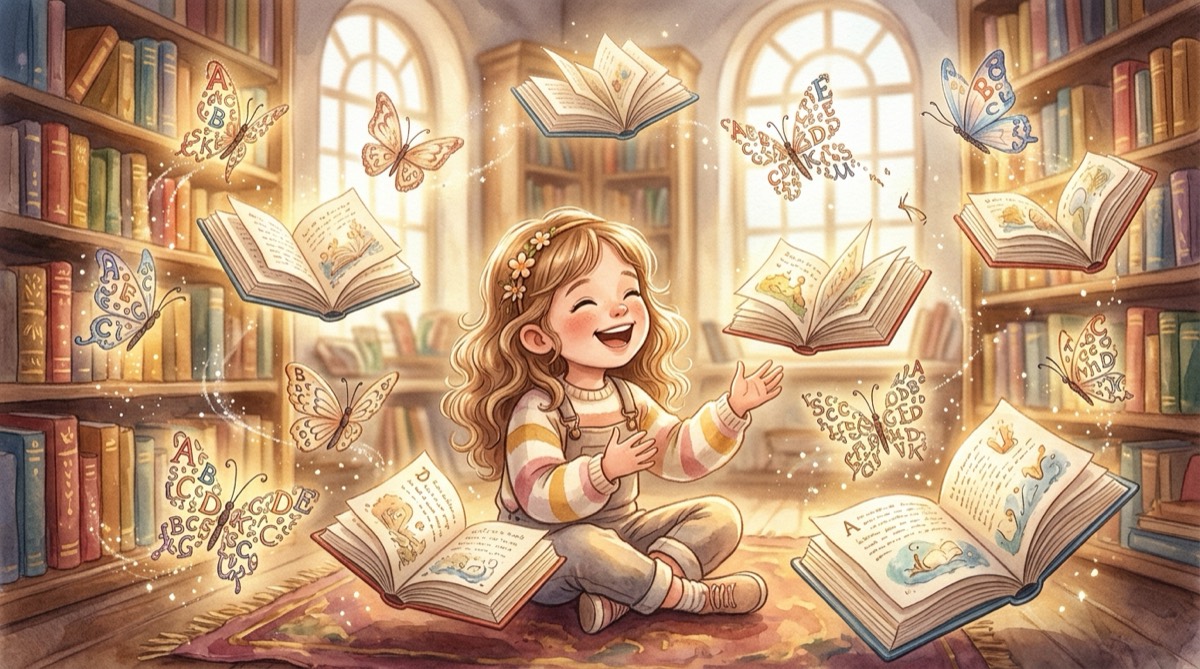
Not all words are equal. In everyday conversation we use a narrow vocabulary made of short, repetitive sentences: "put your shoes on", "finish your plate". Stories, on the other hand, speak of lighthouses, hanging gardens, courage and longing. It is this difference, repeated night after night, that builds a spectacular gap.
The "million word gap"
Researchers at Ohio State University calculated what shared reading represents in words heard (Logan et al., 2019, Journal of Developmental & Behavioral Pediatrics). Their finding is striking: between birth and age 5, a child who is read one book a day hears about 1.4 million more words than a child who is never read to. The researchers called this the "million word gap".
And these are not ordinary words: story vocabulary is rarer, more precise and more vivid than conversational vocabulary. Stories are where a child meets "roar", "shimmer" or "reluctantly" — the words that will make all the difference when they learn to read.
Why those words matter so much
The landmark meta-analysis on the subject (Bus, van IJzendoorn & Pellegrini, 1995) established that shared reading in the preschool years predicts reading success years later. The mechanism is well understood: the more words a child knows by ear, the more easily they recognise them in print. The vocabulary heard at 3 becomes reading fluency at 7.
This is why American paediatricians recommend shared reading from birth (High & Klass, Pediatrics, 2014) — not to raise a prodigy, but because the brain builds its lexicon long before a child says their first word.
The ear comes first
Good news for rushed evenings: the benefit does not depend on the medium. A paper book, an invented tale, an audio story listened to while snuggled together — what matters is the richness of the language heard and the shared moment. A story told aloud, with its intonations and silences, also teaches a child the music of their language: the very music they will later hear in their own silent reading.
Three simple habits to get the most out of it
- One new word, a one-second explanation: "the cliff — that's a big wall of rock"; nothing more needed.
- Let them interrupt: questions during the story double vocabulary learning.
- Reread (or replay) the same story: repetition only bores adults — it is what anchors new words.
With Plume, every story is written especially for your child, in rich, age-appropriate language — and narrated aloud, so the million-word head start keeps building even on nights when there is no book at hand.
What if tonight's story was written for your child?
In a few minutes, Plume invents a one-of-a-kind story — their name, their passions, their day — and narrates it in a gentle voice.
Create their storyReady in under 2 minutes