
Screens Before Bed: Why They Delay Sleep, and What to Replace Them With
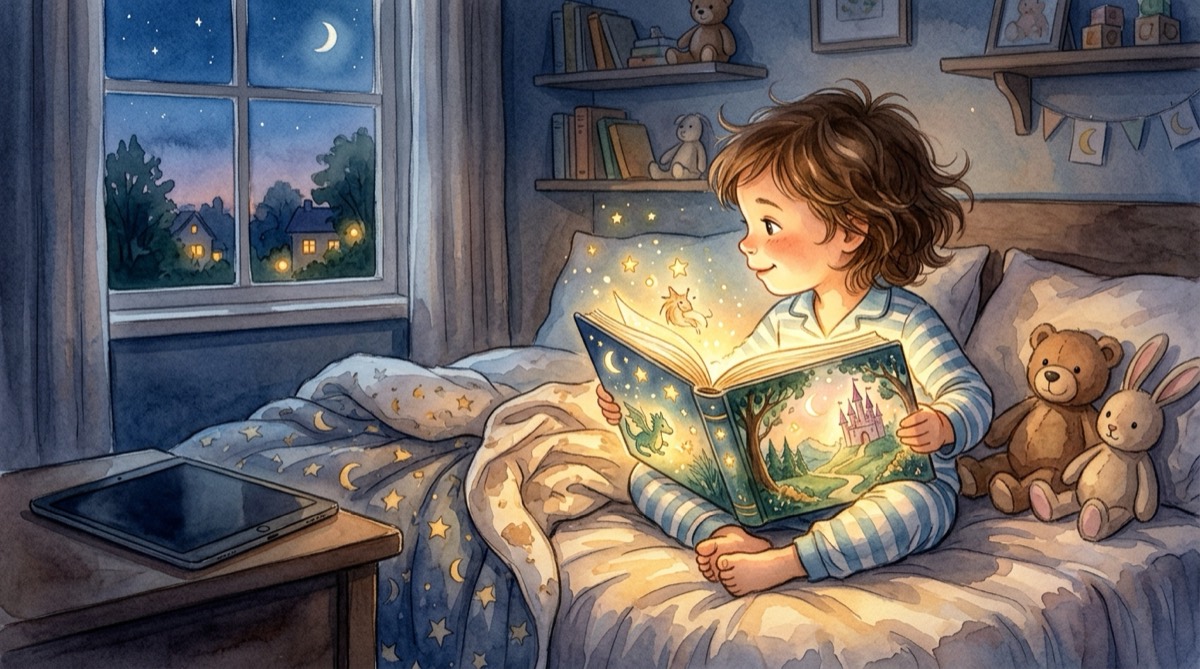
It is often the easy fix on an exhausting evening: a cartoon to buy ten minutes of calm before bed. The problem is that those ten minutes come at a steep price — in delayed sleep onset and night wakings. This is not just parental intuition: it is one of the most robust findings in children's sleep research.
What 67 studies show
A systematic review published in Sleep Medicine Reviews (Hale & Guan, 2015) analysed 67 studies on screens and young people's sleep: 90% of them found screen time associated with later, shorter or poorer-quality sleep. The effect is strongest when the screen is used in the hour before bed or present in the bedroom.
Three well-identified mechanisms
- Blue light: emitted by LED displays, it suppresses melatonin, the hormone that triggers sleep onset. The brain believes it is still daytime.
- Cognitive arousal: fast pacing, surprises, rewards — children's content is engineered to capture attention. The exact opposite of what falling asleep requires.
- Stolen time: every minute of evening screen time mechanically pushes bedtime later, and the deficit compounds week after week.
This is why the American Academy of Pediatrics explicitly recommends avoiding screens in the hour before bedtime and keeping them out of the bedroom ("Media and Young Minds", Pediatrics, 2016).
Replace, don't just remove
Removing a ritual without replacing it guarantees a meltdown. The transition that works substitutes the cartoon with an equally enjoyable but calming pleasure — and that is precisely the role research assigns to the bedtime story, a pillar of effective routines (Mindell & Williamson, 2018).
Audio stories have a particular advantage here: they give a child a "show" as immersive as a cartoon — a voice, characters, suspense — but with no screen, no light, eyes closed. The child does not experience the change as deprivation: they trade one entertainment for another, while their body drifts towards sleep.
The transition, in practice
- Announce the new ritual as a privilege ("tonight you get a story just for you"), not a punishment.
- Keep the time slot: the story takes the cartoon's exact place in the evening.
- Hold on for ten nights: that is roughly how long it takes for the new association to settle.
- Lights out as the story starts if it is audio: sleep often arrives before the ending does.
Plume stories were designed for this exact moment: narrated in a soft, bedtime-paced voice and personalised so your child genuinely wants their new ritual. Many parents tell us the screen → story swap took less than a week.
What if tonight's story was written for your child?
In a few minutes, Plume invents a one-of-a-kind story — their name, their passions, their day — and narrates it in a gentle voice.
Create their storyReady in under 2 minutes